
Pool Heater Repair in Phoenix, AZ
Pool heater repair in Phoenix, AZ usually comes down to five parts and one bad habit. The Pool Shack diagnoses gas heaters and heat pumps from the error code and the flame. What failed gets replaced, and the water that caused it gets checked. Hayward, Pentair, Jandy and Raypak, from our shop in North Phoenix to Scottsdale, Cave Creek, New River and Glendale.
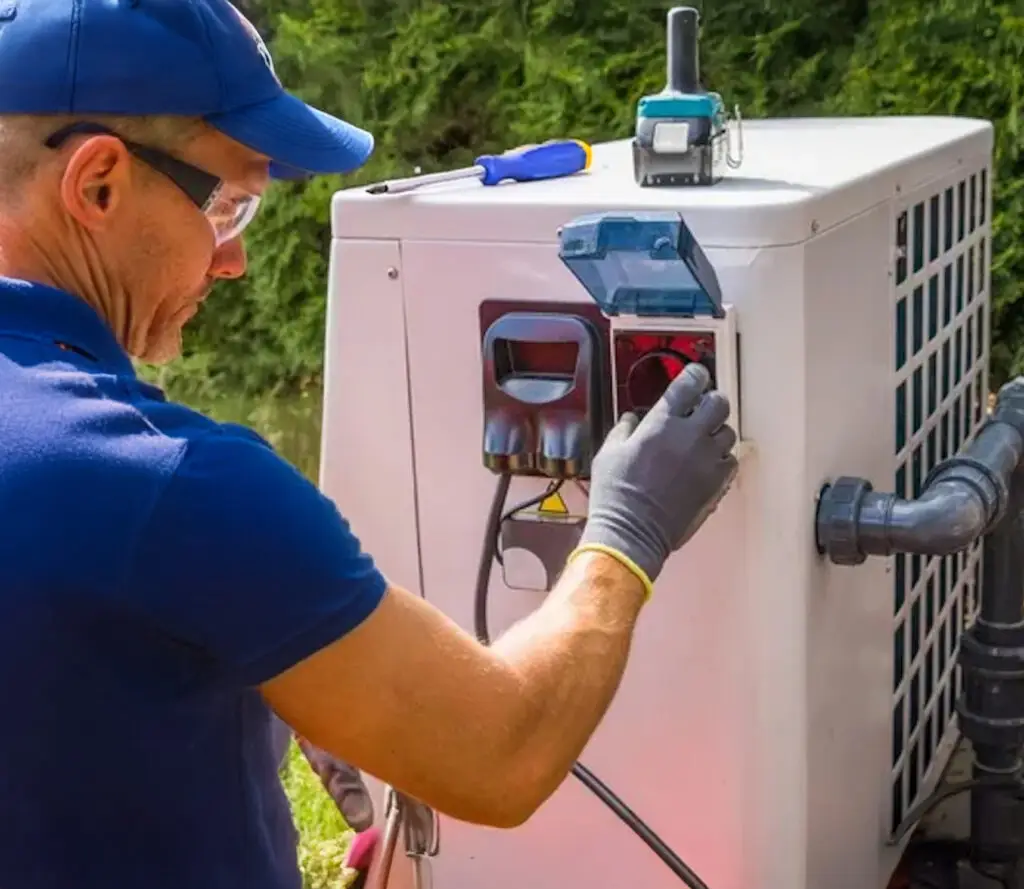
Gas and heat pump
Hayward, Pentair, Jandy, Raypak
What’s included
What a Pool Heater Repair Covers in Phoenix
It happens the first cold weekend. The spa is set to 102, the heater clicks, runs for a minute and shuts off. Or it never lights at all and the display shows a code nobody wrote down. Sometimes it fires, then trips, then fires again all evening while the water stays at 80. The guests are already on the way.
Short cycling does damage. Every failed light cycle wears the igniter and the gas valve. A heater running on low flow overheats its exchanger. And most of what kills a Phoenix pool heater is not the heater at all. Hard water scales the exchanger, chlorine tabs in the skimmer eat the copper, and a dirty filter starves it until the pressure switch gives up.
Pool heater repair from The Pool Shack starts with the code, the flame and the flow. Igniters, flame sensors, pressure switches, thermal regulators, high-limit switches, gas valves and boards are tested and replaced with the maker’s parts. Heat pump capacitors, fan motors and sensors get the same treatment. The exchanger is checked for scale and leaks, the burner tray for nests, and the filter pressure is read so the heater is not fixed twice. Then the water is tested, because the heater that failed was often the water’s fault.
Is it time?
Signs a Phoenix Pool Heater Needs Repair
Most heater failures announce themselves. Each of these points to a different part, which is why the code matters.
Licensed, bonded, insured
Arizona KA-5 dual license
Why it matters
Why Pool Heaters Fail in Phoenix and What a Real Repair Fixes
A pool heater in Phoenix works a short, hard season. It sits idle through summer, then runs every evening from November to March heating a spa from 70 to 102 degrees. Sun, dust, hard water and pack rats all get at it while it waits. Most heater calls trace back to a handful of parts and to the water running through the exchanger. Here is what fails, how each failure shows itself, and what a proper pool heater repair does about it.
Pool heater not turning on: igniters, flame sensors and gas supply in Phoenix
A gas heater that clicks and never lights has a problem in its ignition chain. The hot surface igniter glows to light the gas, the gas valve opens, and the flame sensor confirms fire. If the igniter has cracked, which they do after a few seasons of heat cycles, the gas never lights. If the flame sensor is coated with dust or oxide, the board sees no flame and shuts the gas off after a few seconds. Either way the display shows an ignition failure code.
Gas supply is the other cause. A heater on propane with a low tank, or on natural gas with a meter too small for the heater’s rating, starves at start-up. Spiders and pack rats nest in burner trays over a Phoenix summer. A blocked orifice or a chewed wire looks like an ignition failure until the tray comes out. The repair is the failed part, plus a cleaned tray and a check of gas pressure at the valve.
Igniters and flame sensors are cheap parts, and both are replaced together when either has failed, because the other is the same age.
Why a pool heater fires then shuts off: the pressure switch, flow and a dirty filter
A heater that lights, runs a minute and quits is usually protecting itself. The pressure switch will not let the burner run unless enough water is flowing through the exchanger. Low flow means a dirty filter, a clogged pump basket, a closed valve, a pump set too slow or a switch that has drifted. The heater fires, the flow drops as the pump settles, the switch opens and the burner stops. Then the cycle repeats all evening.
The high-limit switch does the same job for temperature and trips when the exchanger gets too hot, which also comes from low flow. Replacing a pressure switch on a heater with a loaded filter fixes nothing. That is why the repair starts with the filter gauge and the pump speed. Sometimes a filter cleaning is the whole heater repair. On variable-speed pumps the heater needs a minimum speed programmed for heat mode.
Scale in the heat exchanger: the Phoenix hard water problem that kills heaters
The exchanger is a bundle of copper or cupronickel tubes that the flame heats and the water runs through. Hot copper in hard water grows scale on the inside faster than any other surface in the pool system. Scale forms where the water is hottest. A Phoenix pool with calcium at 600 ppm and pH drifting toward 8 lines its exchanger within a couple of seasons. Scaled tubes carry less water, run hotter, trip the high limit and eventually split.
A scaled exchanger can sometimes be flushed with a descaling solution if it is caught early. One that is leaking is replaced, and on a heater more than about ten years old that usually means a new heater. The real repair is the water. Calcium hardness held at 200 to 400 ppm, pH at 7.4 to 7.6 and a saturation index near zero keep the exchanger clean. Nothing else does.
A descaling flush is a maintenance item, not a rescue. Done every couple of seasons on a pool with hard water, it keeps the tubes open. Done once on a heater that has been scaling for a decade, it usually finds the leak that the scale was plugging.
Chlorine tabs, low pH and copper: why the pool heater is leaking and the water is green
The opposite chemistry problem eats the exchanger from the inside. Acidic water dissolves copper. Copper in the pool water shows up as green tint, blue-green stains on the plaster and blonde hair that turns green. The usual cause in Phoenix is chlorine tablets sitting in the skimmer basket. Tabs are acidic. When the pump stops, the water in the skimmer line becomes a strong acid soup that flows straight through the exchanger at the next start.
A heater with pinholed tubes drips from the cabinet, rusts the burner tray from below and is not repairable except by a new exchanger. The fix for the water is a floating dispenser or an inline feeder installed after the heater with a check valve. Nothing acidic reaches the copper. That is a small install that saves a large one, and it is part of every heater repair where tabs turn up in the skimmer.
Heat pump repair in Phoenix: capacitors, fan motors and cold nights
Heat pumps pull heat from the air and work well in Phoenix, where even January afternoons are mild. Their failures are electrical. A start capacitor that swells and fails leaves the compressor humming and not starting. A fan motor that seizes from dust and heat trips the unit on high pressure. Temperature sensors drift and the display reads wrong. Refrigerant leaks are rarer and show as a unit that runs constantly and heats nothing.
Heat pumps also lose output as air temperature drops. A unit that heats the pool fine in October and struggles on a 45-degree night in January is not broken. It is undersized for the job on that night. The repair conversation there is about sizing and run time, or about pairing it with a gas heater for the spa. Capacitors, contactors, fan motors and sensors are replaced on site. Sealed system work is quoted separately.
Dust is the Phoenix heat pump problem. The evaporator coil clogs with the same fine soil that loads the pool filter, and a clogged coil cannot pull heat from the air. Coil cleaning is part of every heat pump repair visit.
Thermal regulators, bypass valves and condensation inside a Phoenix pool heater
Inside the heater header a thermal regulator meters how much water goes through the exchanger and how much bypasses it. That keeps the exchanger hot enough to avoid condensation. When the regulator sticks open, the exchanger runs cold, water vapor in the exhaust condenses on the tubes and drips into the burner tray. The owner sees water under the heater and assumes a leak. The tray rusts, the burners soot up and the heater runs rough.
When the regulator sticks closed, the exchanger overheats and the high limit trips. Both look like other failures until the header is opened. The regulator and the header gaskets are replaced together, because the gaskets never survive being disturbed. A heater that has been dripping for a season also gets its tray and burners cleaned. Soot from a cold-running heater is what causes the burning smell at the vent.
Pool heater error codes and control boards: what the display is trying to tell you
Modern heaters diagnose themselves, up to a point. An ignition failure code, a pressure switch code, a high-limit code or a sensor fault each narrow the search. The first thing a repair technician does is read the code before anyone touches a reset button. Resetting clears the code and the evidence with it. Writing the code down before calling saves a trip.
Control boards do fail, from heat, from a nearby lightning strike during monsoon season or from a rodent across the terminals. A board is replaced only after the parts around it test good. It is the most expensive part on the heater and the one most often replaced by mistake. Wiring, transformers and fuses get checked first. On heaters tied into a pool automation system, the automation gets checked too, since a bad relay looks like a dead heater.
Pool heater repair cost in Phoenix and when replacement makes more sense
Phoenix market pricing in 2026 runs about $100 to $200 for a diagnostic visit and $200 to $400 for an igniter or flame sensor. A pressure switch runs $150 to $300, a thermal regulator with gaskets $250 to $450, and a control board $300 to $600. A heat exchanger runs $800 to $1,500 installed. Heat pump capacitors and fan motors run $150 to $500. Those are market ranges, not our quote.
The replace line is the exchanger. On a heater under eight years old with a sound cabinet, a new exchanger is worth it. On one older than ten, or one that has already been through a board and a regulator, the money is better spent on a new pool heater. It comes with a warranty and a better efficiency rating. You get both numbers in writing and the reasoning beside them.
Pool heater repair from North Phoenix to Scottsdale and Cave Creek by a licensed crew
The Pool Shack repairs gas heaters and heat pumps across North Phoenix, Scottsdale, Paradise Valley, Cave Creek, New River and Glendale. Every call runs from our North Phoenix base. The work runs under an Arizona KA-5 dual license, which covers service and construction. Gas heater work touches gas lines and electrical, and a license is what stands behind that on a home.
Hayward, Pentair, Jandy and Raypak heaters make up most of the calls, and the common igniters, switches and sensors are stocked. Pools on our weekly pool service route get the heater checked every visit. A dripping cabinet or a sooty vent gets caught before the first cold night. One-time repairs start with the code and a written price. Family-owned since 2015, licensed, bonded and insured.
Getting started
How a Pool Heater Repair Runs
1
Code read, flame and flow checked
Error code recorded before any reset, filter pressure and pump speed verified, gas pressure tested at the valve.
2
Failed part replaced with the maker’s part
Igniters, sensors, switches, regulators, boards, capacitors and motors, with the burner tray cleaned while it is open.
3
Run to temperature and the water tested
Heater cycled to set point and watched, then calcium, pH and where the chlorine is fed checked so it does not fail again.
Get a quote
Get a Quote for Pool Heater Repair
Tell us the heater brand and model, gas or heat pump, and what it does when you turn it on. Any code on the display helps. We will price the repair in writing.
Related services
Services That Go With Pool Heater Repair
Pool Heater Installation
A new gas heater or heat pump sized for the pool and spa, when the exchanger is done or the heater is past ten.
Learn More
Pool Filter Cleaning
Restores the flow a heater needs, and fixes half the heaters that fire and shut off.
Learn More
Spa Repair
Jets, blowers, controls and the spa-side plumbing the heater feeds, fixed by the same licensed crew.
Learn More
Common questions
Pool Heater Repair Questions From Phoenix Pool Owners
Why is my pool heater not turning on?
Most often a cracked igniter, a dirty flame sensor, low gas supply or a blocked burner tray. The display code narrows it. Write the code down before pressing reset, because a reset clears the evidence.
Why does my pool heater turn on and then shut off?
Low water flow. The pressure switch or high limit stops the burner when flow drops. A dirty filter, clogged basket, closed valve or a pump running too slow is the usual cause. Replacing the switch alone rarely fixes it.
How much does pool heater repair cost in Phoenix?
Market rates in 2026 run about $100 to $200 to diagnose, $200 to $400 for an igniter, $150 to $300 for a pressure switch, $300 to $600 for a board and $800 to $1,500 for an exchanger.
Is it worth repairing a pool heater or should I replace it?
Repair for igniters, sensors, switches, regulators and boards on a heater under about ten years old. Replace when the exchanger fails on an older heater, or when a second major part goes within a couple of seasons.
Do you repair pool heaters in Scottsdale, Cave Creek and New River?
Yes. Heater repairs run from our North Phoenix base across North Phoenix, Scottsdale, Paradise Valley, Cave Creek, New River and Glendale. Call (480) 798-2888 with the brand and the code on the display.
Why is water leaking from under my pool heater?
Either condensation from an exchanger running cold, usually a stuck thermal regulator, or a pinholed exchanger. Condensation is a repair. A leaking exchanger on an old heater usually means replacement.
Why is my pool water green after running the heater?
Copper dissolving out of the exchanger. Acidic water, most often from chlorine tabs in the skimmer, eats the copper tubes. The fix is moving the chlorine feed after the heater and balancing pH, then treating the copper.
How long should a pool heater last in Arizona?
Ten to fifteen years with balanced water and no tabs in the skimmer. Scaled or acidic water can finish an exchanger in five. Heat pumps run about the same when their fan and capacitors are serviced.
Can a heat pump heat a spa in Phoenix in winter?
Slowly. Heat pump output drops with air temperature, so a spa that heats in an hour with gas may take several on a 45-degree night. Many Phoenix owners run a heat pump for the pool and gas for the spa.
Why does my pool heater smell like something is burning?
Soot from a cold-running or poorly venting burner, a nest in the burner tray, or a wire on a hot surface. Shut it off and have it checked. A sooting heater is wasting gas and can crack the exchanger.
Where We Work
Proudly Serving the Phoenix Area
- Phoenix
- Scottsdale
- Tempe
- Mesa
- Chandler
- Gilbert
- Glendale
- Peoria
Ready When You Are
Book a Pool Heater Repair in North Phoenix
Gas heaters and heat pumps fixed with the maker’s parts by a KA-5 licensed, family-owned crew, from North Phoenix across the Valley.